Friday, 8 April 2011

Libyan minister to take Turkish peace plan to Gaddafi

Rebels also 'positive' about three-point plan after separate meeting with Turkish officials

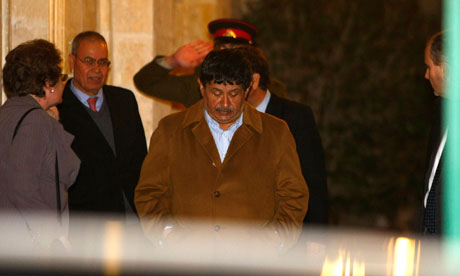
Libya's new foreign minister Abdel Ati al-Obeidi will present the proposal to Muammar Gaddafi, said Turkish government sources. Photograph: Darrin Zammit Lupi/Reuters

Turkey has proposed a path to a peaceful resolution to the deadlocked conflict in Libya, involving a withdrawal by Muammar Gaddafi's forces from cities held by the rebels, and democratic reform.

Recep Tayyip Erdogan, the Turkish prime minister, has outlined the proposal in Ankara, saying: "We are working on the details of this roadmap." It would include humanitarian corridors in Libya, he said.

Turkey, which this week hosted an envoy from the Gaddafi regime, the new foreign minister, Abdel Ati al-Obeidi, said the measures would be discussed at an international meeting on Libya in Qatar next week. The US, European countries and Middle Eastern allies will take part.

Obeidi was reported to be floating ideas for a three-country tour in search of a political solution, with Gaddafi staying in power while constitutional reforms were introduced. Libya's opposition and the international coalition reject any plan involving Gaddafi remaining in power.

Erdogan outlined three elements to his proposal: a ceasefire in the cities surrounded by Gaddafi's forces, including Misrata; a humanitarian corridor to allow aid to enter, co-ordinated with Tripoli; and negotiations leading to a new political process in Libya, including free elections.

Sources close to Erdogan said he had discussed the proposal with Obeidi, who would take the message back to Tripoli.


The Turkish government also met Mustafa Abdul Jalil, the chairman of the rebel council, in Doha recently. Jalil was said to have been "positive" about the proposal.

Meanwhile, Nato is investigating a claim by Libyan rebels that a botched air strike has killed at least 13 of its fighters as the west scrambled to deal with what commanders admit is a flaw in communications with rebels on the battlefield.

The revolutionary leadership sought to defuse anger at Nato over the strike near the frontline town of Brega, where several missiles hit rebel tanks, by claiming that it was carried out by Gaddafi's air force. That appeared unlikely given the imposition of the no-fly zone and the destruction of his air defences in recent days.

The Nato aircraft appear not to have been informed that, for the first time, rebels had moved several tanks, rocket launchers and other armour up to the frontline . All of it was seized from government forces and therefore was indistinguishable from Gaddafi's weaponry.

But the second Nato attack on rebel forces in less than a week deepened anger and suspicion about the actions of the alliance, which is accused in rebel-held areas of abandoning the fight against Gaddafi. Nato had been keen to assuage those concerns by demonstrating that it is still taking on the Libyan leader's army.

A rebel commander, Ayman Abdul-Karim, told the Associated Press that he had seen air strikes hit tanks and a rebel convoy, including a bus carrying fighters toward Brega. He and other rebels described dozens killed or wounded.

Rebel fighters who saw the strike were furious. "Nato are liars. They are siding with Gaddafi," said Salem Mislat.

Thirteen people, including three doctors, died last Friday in a western air raid after rebels opened fire with an anti-aircraft gun while a Nato plane was overhead.

Yesterday's incident came as western powers tried to improve slow communications between the rebels and Nato commanders, who are receiving old information about the situation on the ground.

A fresh assault by Gaddafi's forces appeared to be pushing the revolutionaries back once again. The government army advanced close enough to Ajdabiya, the last main town before the revolutionaries' de facto capital, Benghazi, to shell its western gate. That sent people fleeing in their thousands from Ajdabiya, which has changed hands several times.

The revolutionaries' military problems are being compounded by a looming economic crisis. Western governments that have established diplomatic ties with the revolutionary council are now urgently trying to find ways to legally get frozen Libyan assets to the rebel administration, which says it has less than a fortnight's cash available.

The matter is complicated by UN sanctions against Libyan state bodies, which appear to prevent western governments from transferring funds in to banks even in rebel-held territory. The US holds about £20bn in Libyan assets and Britain has several billion, but officials say releasing the funds is proving legally complicated.

The economic crisis is likely to be compounded by plunging oil production that was cut further on Wednesday by an attack on a pumping station. Nato dismissed the regime's claims that British planes were responsible for the attack, saying it was carried out by Gaddafi's forces.

The American general who heads the US's Africa command, Carter Ham, told Congress that he believes the conflict is settling into a stalemate. He advised against providing weapons to the rebels until the US is confident about who exactly they are, amid warnings from other members of the American military about ties to Islamist extremists.

However, that concern is rapidly receding among western diplomats dispatched to Benghazi to deal with the rebels who say that they have been impressed by a commitment to creating a free and democratic society.


Libyan spokesman Musa Ibrahim said he was not aware of the details of the plan, but added: "We are open to all proposals for reform from within Libya."

Thursday, 7 April 2011

Mr.Obama please help us

Dispatches - Libya

http://english.aljazeera.net/indepth/spotlight/libya/

Dispatches - Libya

http://english.aljazeera.net/indepth/spotlight/libya/

Dispatches Libya.

http://english.aljazeera.net/indepth/spotlight/libya/

150 migrants missing after boat from Libya sinks off Italy

Italian rescue vessels resume search for survivors – but hopes of finding anyone alive are fading, warns interior minister

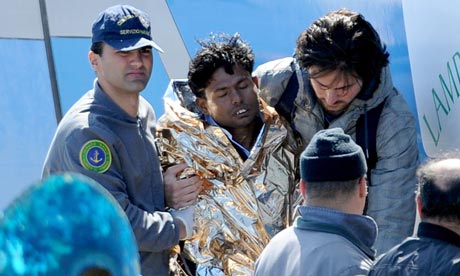
A survivor from the capsized boat, which set sail from Libya, is wrapped in foil and taken to Lampedusa for medical treatment. Photograph: Ettore Ferrari/EPA

Italian rescue vessels have resumed their search for survivors from the boat carrying refugees from Libya that sank south of Sicily on Wednesday but hopes of finding anyone alive are fading.

The interior minister, Roberto Maroni, said 51 people, most from central Africa, had been picked up by rescue vessels responding to a distress signal sent via Maltese authorities.

"Survivors said there were another 150 people, and the search for them is being conducted at sea at the moment with the help of two merchant ships," he told parliament. "The search is continuing but hopes of finding anyone still alive grow weaker by the hour," he said.

The incident was the most dramatic of its kind for some time, but many smaller boats carrying migrants have sunk while attempting to reach southern Europe from Africa, killing unknown numbers of refugees and migrants.

Officials said the boat, which left Libya on Monday and was loaded well above capacity, capsized after its motor failed. Although the vessel was in Maltese waters when it got into difficulties, Italian rescue ships were alerted because of a lack of appropriate vessels in Malta, Maroni said.

Survivors have been housed in a reception centre in Lampedusa, the southern Italian island at the centre of a recent north African migrant crisis, but there has been uncertainty about the number of people on the boat when it sank.

The International Organisation for Migration, an agency with officials on Lampedusa, says there were 300 passengers on board; Italian officials estimate there were 200.
Libya: US rebuffs letter from Gaddafi, says he must go

Rebel forces kept up attacks in the west on Wednesday
Continue reading the main story
Libya Crisis
Rebels race to train recruits
Frontline hospital
How war is being funded
Challenges facing coalition

The US has rebuffed a personal appeal from Libyan leader Muammar Gaddafi to US President Barack Obama, repeating that he must resign and go into exile.

"Mr Gaddafi knows what he must do," US Secretary of State Hillary Clinton said, commenting on the three-page letter received by the president.

Colonel Gaddafi urged Mr Obama in his letter to end an "unjust war".

An unconfirmed report from Libya says a coalition air strike has damaged a disputed oil pipeline.

Khaled Kaim, a deputy foreign minister in Col Gaddafi's government in Tripoli, told reporters that three guards had been killed and other staff injured during an air strike by British jets on the Sarir oilfield in the Sirte basin.
Continue reading the main story
“
Start Quote

I don't think there is any mystery about what is expected from Mr Gaddafi at this time”
Hillary Clinton
US secretary of state

However, the oilfield has been under rebel control, and the rebels reported attacks this week by Libyan government forces in the area, which forced a halt to oil production.

There was no immediate official comment from the UK's Ministry of Defence on the Libyan government report.

But on Wednesday afternoon, it reported that British jets had hit targets around Sirte and Misrata, attacking armoured fighting vehicles and tanks.
'Our son'

A White House spokesman responded to Col Gaddafi's letter, a copy of which was obtained by the Associated Press news agency, by saying actions, not words, were needed from the Libyan leader.


Tim Wilcox spoke to one of the opposition leaders, who wished to remain anonymous

American warplanes are no longer involved in the air strikes on Libya - a fact hailed by Col Gaddafi in his letter.

Referring to Barack Obama as "our son", the Libyan leader urged the US leader to end an "unjust war against a small people of a developing country", and dismissed the rebels as "al-Qaeda" militants.

His nation, he said, had been been hurt "morally" more than "physically".

Mrs Clinton said in Washington: "I don't think there is any mystery about what is expected from Mr Gaddafi at this time.

"There needs to be a cease-fire, his forces need to withdraw from the cities that they have forcibly taken at great violence and human cost...
Continue reading the main story
“
Start Quote

As you know too well democracy and building of civil society cannot be achieved by means of missiles and aircraft”
Libya's Colonel Gaddafi
Text of Gaddafi letter

"There needs to be a decision made about his departure from power and... his departure from Libya."

In another development, a former US congressman has arrived in Tripoli at the invitation of the Libyan government.

Curt Weldon says he will urge Mr Gaddafi to "step aside", and is suggesting that his forces pull back from western cities under siege while rebel fighters do not try to advance any further from the east.

The White House was informed about the visit in advance but a spokesman stressed that Mr Weldon was not an official envoy.
Change of tactics

Nato has promised to do everything it can to protect civilians in the west Libyan city of Misrata which is besieged by Col Gaddafi's forces.

Rebel leaders have predicted a massacre there within a week unless Nato takes more decisive action.

The BBC's Wyre Davies reports from rebel-held eastern Libya that rebel forces remain enthusiastic but ill-disciplined, despite attempts by the few former regular soldiers among their ranks to try to coordinate their operations.

It is a safe bet that after firing off their rockets and mortars in the general direction of the enemy, the same rebels will come charging back, unable or unwilling to dig in and take on Col Gaddafi's better-trained troops, our correspondent says.

Meanwhile, government forces have adapted their efforts to frustrate Nato air strikes, no longer using tanks or other military vehicles that could easily be identified and attacked.

They are using the same pick-up trucks and civilian guise as the rebel fighters, our correspondent says.

Col Gaddafi's opponents are still not in immediate danger of losing strongholds like Benghazi but nor are they in any shape to make significant advances on the ground without more Nato air strikes, he adds.

Wednesday, 6 April 2011

http://www.youtube.com/watch?v=tcka0pJL6X8

Who is Gaddafi?

How can you adequately describe someone like Muammar Gaddafi? During a period that has spanned six decades, the Libyan leader has paraded on the world stage with a style so unique and unpredictable that the words "maverick" or "eccentric" scarcely do him justice.


His rule has seen him go from revolutionary hero to international pariah, to valued strategic partner and back to pariah again.

He has developed his own political philosophy, writing a book that is - in the eyes of its author, at least - so influential that it eclipses anything dreamt up by Plato, Locke or Marx.
Continue reading the main story
Gaddafi on women - and 'insanity'

"Freedom of expression is the right of every natural person, even if a person chooses to behave irrationally, to express his or her insanity"

"Women, like men, are human beings. This is an incontestable truth... Women are different from men in form because they are females, just as all females in the kingdom of plants and animals differ from the male of their species... According to gynaecologists women, unlike men, menstruate each month... Since men cannot be impregnated they do not experience the ailments that women do"

Both excerpts from the Green Book

He has made countless show-stopping appearances at Arab and international gatherings, standing out not just with his outlandish clothing, but also his blunt speeches and unconventional behaviour.

One Arab commentator recently called him the "Picasso of Middle East politics", although instead of Blue, Rose or Cubist periods, he has had his pan-Arab period, his Islamist period, his pan-African period, and so on.
Early promise

In the heady days of 1969 - when he seized power in a bloodless military coup - and the early 1970s, Muammar Gaddafi was a handsome and charismatic young army officer.

An eager disciple of President Gamal Abdel Nasser of Egypt (he even adopted the same military rank, promoting himself from captain to colonel after the coup), Gaddafi first set about tackling the unfair economic legacy of foreign domination.

For Nasser, it was the Suez Canal. For Gaddafi, it was oil.

Significant reserves had been discovered in Libya in the late 1950s, but the extraction was controlled by foreign petroleum companies, which set prices to the advantage of their own domestic consumers and benefited from a half share in the revenue.

Col Gaddafi demanded renegotiation of the contracts, threatening to shut off production if the oil companies refused.

Gaddafi was a huge admirer of Egypt's Gamal Abdel Nasser, who led the Egyptian Revolution of 1952

He memorably challenged foreign oil executives by telling them "people who have lived without oil for 5,000 years can live without it again for a few years in order to attain their legitimate rights".

The gambit succeeded and Libya became the first developing country to secure a majority share of the revenues from its own oil production. Other nations soon followed this precedent and the 1970s Arab petro-boom began.

Libya was in a prime position to reap the benefits. With production levels matching the Gulf states, and one of the smallest populations in Africa (less than 3m at the time), the black gold made it rich quickly.
Political theorist

Rather than persevering with the doctrines of Arab Nationalism, or following the glittering excesses of Gulf consumerism, Col Gaddafi's innately mercurial character led him and Libya on a new path.

Born to nomadic Bedouin parents in 1942, Muammar Gaddafi was certainly an intelligent, resourceful man, but he did not receive a thorough education, apart from learning to read the Koran and his military training.

Nevertheless, in the early 1970s he set out to prove himself a leading political philosopher, developing something called the third universal theory, outlined in his famous Green Book.
Continue reading the main story
On the Arab world and Africa

"Libya is an African country. May Allah help the Arabs and keep them away from us. We don't want anything to do with them" Libyan TV, March 2007

"I am an international leader, the dean of the Arab rulers, the king of kings of Africa and the imam of Muslims, and my international status does not allow me to descend to a lower level" Arab League summit, March 2009

The theory claims to solve the contradictions inherent in capitalism and communism (the first and second theories), in order to put the world on a path of political, economic and social revolution and set oppressed peoples free everywhere.

In fact, it is little more than a series of fatuous diatribes, and it is bitterly ironic that a text whose professed objective is to break the shackles imposed by the vested interests dominating political systems has been used instead to subjugate an entire population.

The result of Col Gaddafi's theory, underlined with absolute intolerance of dissent or alternative voices, has been the hollowing out of Libyan society, with all vestiges of constitutionality, civil society and authentic political participation eradicated.

The solution to society's woes, the book maintains, is not electoral representation - described by Gaddafi as "dictatorship" by the biggest party - or any other existing political system, but the establishment of people's committees to run all aspects of existence.

This new system is presented diagrammatically in the Green Book as an elegant wagon wheel, with basic popular congresses around the rim electing people's committees that send influence along the spokes to a responsive and truly democratic people's general secretariat at the centre.

The model that was created in reality was an ultra-hierarchical pyramid - with the Gaddafi family and close allies at the top wielding power unchecked, protected by a brutal security apparatus.

In the parallel world of the Green Book, the system is called a Jamahiriyya - a neologism that plays on the Arabic word for a republic, Jumhuriyya, implying "rule by the masses".

Gaddafi's 'system' as envisaged in the Green Book

So the long-suffering Libyan masses were dragooned into attending popular congresses vested with no power, authority or budgets, with the knowledge that anyone who spoke out of turn and criticised the regime could be carted off to prison.

For a system that was designed to end oppression and dictatorship, a set of draconian laws was enacted in the name of upholding security.

They include laws allowing collective punishment, death for anyone who spreads theories aiming to change the constitution and life imprisonment for disseminating information that tarnishes the country's reputation.

Tales abounded of torture, lengthy jail terms without a fair trial, executions and disappearances.

Many of Libya's most educated and qualified citizens chose exile, rather than pay lip service to the lunacy.
Adventures abroad

Unchecked by any of the normal restraints of governance, Col Gaddafi was able to take his anti-imperialist campaign around the world, funding and supporting militant groups and resistance movements wherever he found them.

He also targeted Libyan exiles, dozens of whom were killed by assassins believed to belong to a global Libyan intelligence network.

If more conventional governments were prepared to shrug off his human rights violations at home and persecution of dissidents abroad, supporting groups that used terrorism on their own patches was a different matter.

A bombing of a nightclub used by US soldiers in Berlin in 1986, blamed on Libyan agents, proved a decisive moment.
Continue reading the main story
On democracy and opposition

"There is no state with a democracy except Libya on the whole planet"

"In the Middle East, the opposition is quite different than the opposition in advanced countries. In our countries, the opposition takes the form of explosions, assassinations, killings "

Address to US Academics, March 2006

US President Ronald Reagan ordered air strikes against Tripoli and Benghazi in retaliation for the two soldiers and one civilian killed and the dozens of wounded, although there was no conclusive proof beyond intelligence "chatter" that Libya had ordered the attack.

The US retaliation was intended to kill the "mad dog of the Middle East", as Mr Reagan branded him, but although there was extensive damage and an unknown number of Libyan fatalities - including, it was claimed, Gaddafi's adopted daughter - the colonel emerged unscathed.

His reputation may even have been enhanced among opponents of Washington's heavy-handed foreign policy.

The bombing of Pan-Am flight 103 over the Scottish town of Lockerbie in 1988 was the next significant escalation, causing the deaths of 270 people in the air and on the ground, the worst single act of terrorism ever witnessed in the UK.

Gaddafi's initial refusal to hand over the two Libyan suspects to Scottish jurisdiction resulted in a protracted period of negotiations and UN sanctions, finally ending in 1999 with their surrender and trial. One of the men, Abdelbaset Ali al-Megrahi, was jailed for life, but the other was found not guilty.
A new detente?

The resolution of the Lockerbie case, along with Col Gaddafi's subsequent admission and renunciation of a covert nuclear and chemical weapons programme, paved the way for a significant warming of relations between Tripoli and western powers in the 21st century.

The domestication of the erstwhile "mad dog" was held up as one of the few positive results of US President George W Bush's military invasion of Iraq in 2003.

The argument went that Col Gaddafi had watched the fate of fellow miscreant Saddam Hussein, hanged by Iraqis after a US-instigated legal process, and had learnt a sobering lesson.

It is perhaps more plausible to argue that the Libyan leader played his WMD card when he saw the benefits of forging strategic partnerships with the US and European powers.

Tony Blair visited Gaddafi at his luxurious Bedouin tent after sanctions were lifted

He certainly paid little heed to Mr Bush's so-called "freedom agenda", which held that the US no longer held common cause with dictators and despots and that democracy and human rights were just around the corner.

It was after all more or less business as usual between Washington and the other authoritarian Arab rulers whom the US called friends and allies.

With international sanctions lifted, Tripoli was back on the international political itinerary, allowing British Prime Minister Tony Blair, among other luminaries, to drop in at Col Gaddafi's famously luxurious Bedouin tent erected in his palace grounds.

In true nomadic style, the tent also went with the colonel on trips to Europe and the US, although in New York state it fell foul of stringent zoning regulations on the estate of tycoon Donald Trump and had to be hastily dismantled.

Distaste about the alleged architect of Lockerbie's readmission into the world leaders' club lingered in many circles, not least among the US victims' families and their supporters.
Continue reading the main story
Col Muammar Gaddafi
Born in Sirte, Libya 7 June 1942
Attended military academy in Libya, Greece and the UK
Seized power on 1 September 1969
The Green Book published in 1975
Married twice, with seven sons and one daugther

But that did not stop business deals being struck with a succession of western defence manufacturers and oil firms.

Ironically, it was on the Arab front that Col Gaddafi kept his black sheep status alive.

Throughout the 2000s, the normally staid proceedings of annual summits of the Arab League were almost guaranteed to be disrupted by the Libyan leader's antics, whether it was lighting up a cigarette and blowing smoke into the face of his neighbour, or tossing insults at Gulf rulers and the Palestinians, or declaring himself "king of kings of Africa".

The UN has also witnessed the colonel's eccentricity. At the 2010 General Assembly, he gave a rambling speech more than an hour-and-a-quarter longer than his allocated 10-minute time slot, tearing out and screwing up pages from the UN Charter as he spoke.
Rebellion

When the winds of revolt started to blow through the Arab world from Tunisia in December 2010, Libya was not at the top of most people's list of "who's next".

The combination of water and oil gave Libya a sound economic platform

Colonel Gaddafi fitted the bill as an authoritarian ruler who had endured for more years than the vast majority of his citizens could remember. But he was not so widely perceived as a western lackey as some Arab leaders accused of putting outside interests before those of his people.

He had redistributed wealth - although the enrichment of his own family from oil revenues and other deals was hard to ignore and redistribution was undertaken more in the spirit of buying loyalty than promoting equality.

He sponsored grand public works, such as the improbable Great Man-Made River project, a massive endeavour inspired, perhaps, by ancient Bedouin water procurement techniques, that brought sweet, fresh water from aquifers in the south to the arid north of his country.

There was even something of a Tripoli Spring, with long-term exiles given to understand that they could return without facing persecution or jail.

When the first calls for a Libyan "day of rage" were circulated, Col Gaddafi pledged - apparently in all seriousness - to protest with the people, in keeping with his myth of being the "brother leader of the revolution" who had long ago relinquished power to the people.

As it turned out, the scent of freedom and the draw of possibly toppling the colonel, just as Egypt's Mubarak and Tunisia's Ben Ali had been toppled, was too strong to resist among parts of the Libyan population, especially in the east.

Some of the first footage of rebellion to come out of Benghazi showed incensed young Libyans smashing up a green monolith outside an official building representing the spurious liberation doctrine that had kept them enslaved since the 1970s, the Green Book.

It was probably inevitable that Col Gaddafi would fight back with everything in his armoury in order to hold on to power. There is nothing in his past to suggest he would do otherwise.

But his days of flamboyant appearances in New York, the capitals of Europe and the Arab world, are now behind him. So too the spell which he once cast over Libyans with his "universal theory".

Gaddafi supporters demolish Zawiya rebel mosque


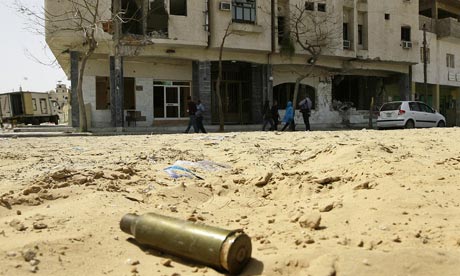
A mosque that became a focal point of the anti-Gaddafi rebellion during fierce fighting in the western town of Zawiya has been razed by city authorities loyal to the Libyan leader.

Rubble from the demolition of the mosque, which was badly damaged during battles that raged for more than a week, has been cleared, leaving a vast expanse of bare earth in central Zawiya.

Evidence of fighting remains in the shelled and bullet-pocked buildings lining the central square, their windows blown out and gaping holes in their walls.

The Zawiya Jewel hotel has been abandoned along with many other buildings. In a small park opposite the site of the mosque the bodies of about 20 rebel fighters have been removed from their makeshift graves. A huge loyalist green flag flies from the post where rebels had raised their tricolour.

On a government-organised trip to the town, 30 miles west of Tripoli, with journalists accompanied by a large group of minders, it was impossible to find a consistent explanation for the mosque's destruction – an unusual act in a Muslim society.

One bystander said the structure had become unstable and was razed for safety reasons. Another said it was destroyed because it had become a haven for al-Qaida. "There were drugs, alcohol and dirty women inside," the man said.

Journalists were shown the carcass of a police station – the minders said it was shelled and burnt by rebel forces looking for weapons. In one blackened room, amid a pile of charred documents, lay photographs that appeared to show detainees injured and possibly tortured. Papers covered with fingerprints were scattered on the floor; broken glass crunched underfoot.

In the teaching hospital on the outskirts of Zawiya, where most beds appeared unoccupied, staff spoke of treating the injured and dying from the battle. Rebel fighters and government soldiers had been treated equally, most insisted.

But Mohammed al-Araby, a consultant surgeon, said he had heard rumours that some doctors refused to treat wounded soldiers loyal to Gaddafi. He himself had abided by the Hippocratic oath to practise medicine ethically, but he had seen clear reluctance in some doctors' faces.

Reliable numbers of the dead and wounded were impossible to obtain, although Massoud Edeeb, head of surgery, cautiously said that up to 100 people may have died.

According to Araby, opposition forces had removed their wounded after initial treatment for fear that they would be taken by loyalists. As government forces gained ascendancy in Zawiya a final group of injured rebel soldiers were removed from the hospital by the military for investigation, he said.

A group of white-clad female medics mounted a noisy pro-Gaddafi demonstration for the benefit of the visiting foreign media. In the central square traffic was held up as loyalists clad in Gaddafi-green scarves and bandanas chanted and sang their support from cars and pick-up trucks.
Libya: Rebel leader accuses Nato of failing civilians

Hundreds of people have been wounded in the fighting in Misrata
The Libyan rebel commander, Gen Abdul Fattah Younis, has accused Nato of standing idly by while pro-Gaddafi forces kill people in Misrata.
If Nato waited another week to intervene, the besieged city's people faced extermination, he told reporters in the de facto rebel capital Benghazi. A Nato-led coalition mandated by the UN to protect civilians is enforcing a no-fly zone and attacking ground targets.
It accuses Gaddafi forces of sheltering weapons in civilian areas.
A tanker reportedly arrived at the eastern port of Tobruk on Tuesday to pick up the first consignment of oil to be exported from the rebel-held region.
The Greek-owned ship is capable of carrying more than $100m worth of oil.
Since the revolt against Colonel Muammar Gaddafi's rule began nearly two months ago, exports of Libya's main commodity have collapsed, driving up the price of oil to a two-and-a-half year high.
In another development, the Gaddafi government made senior diplomat Abdelati Obeidi its new foreign minister, replacing Moussa Koussa, who sought refuge on the UK last week.
'Human shields'
Gen Younis accused Nato of "not doing anything" despite its UN mandate and complained of what he called an overly bureaucratic process that resulted in Nato taking hours to respond to events on the ground.
Continue reading the main story
“
Start Quote

If Nato should wait another week, there will be no more Misrata”
Gen Abdul Fattah Younis
Libyan rebel commander

The general, who was Col Gaddafi's interior minister before he defected to the rebels in February, said Nato could have already lifted the siege of Misrata, the only sizeable town in western Libya still under rebel control.

Nato was concerned about killing civilians, he said, but there were "no civilians in the area where Gaddafi forces are".

"If Nato should wait another week, there will be no more Misrata," he added. "You will not find anyone."

Nato says international air strikes have reduced Col Gaddafi's military capabilities by nearly a third but his forces have deliberately moved weaponry into civilian areas to hamper air strikes.

"When human beings are used as shields we don't engage," Brig Gen Mark van Uhm, a senior Nato staff officer, said in Brussels.

Pro-Gaddafi forces, he added, were resorting more and more to using trucks and light vehicles, "keeping more heavy equipment like armoured vehicles [hidden]".

"So, without even targeting them, we already have an effect in that he can't use them," he said.

The Pentagon has confirmed it has ended its strike mission after flying a total of 1,600 sorties, 600 of them strike sorties, but it continues to provide support to Nato such as air-to-air refuelling and intelligence-gathering.

Nato says the fighting in and around Misrata is its number one focus. It is increasing its reconnaissance missions to track what is going on on the ground.
Oil movement

The arrival of the oil tanker was announced by the shipping paper Lloyds List but not immediately confirmed by the opposition leadership.

Its arrival enables the Libyan opposition to begin earning revenue for the first time from the oil fields under its control, the BBC's Jon Leyne reports from Benghazi.

Qatar is acting as a middleman, effectively shielding whoever buys the oil from any legal arguments.

Eventually the shipment is likely to end up in one of European refineries best suited to handle Libyan crude.

It will also free up storage capacity in Tobruk, important because oil needs to continue moving through the Libyan pipeline network to stop it becoming clogged up with wax.

However, it may not all be plain sailing, our correspondent adds.

There are reports of a Libyan government military attack on one of the oil fields that supplies Tobruk. One or more of the storage tanks was set on fire at the field, in the far south-east of the country.

NATO leaders accused of failing

http://www.bbc.co.uk/news/world-africa-12981237

Tuesday, 5 April 2011

Specialist Report - The West's unwanted war in Libya

Some of your comments:

Neurochuck wrote:
 
Interesting.
Solid, larger analysis can be published on the web without the print run, distribution, retailing overheads of old. Income should be much more to the content producer and web publisher.
Once upon a time, a market seller in Tunisia set fire to …
the Arab order, NATO, European unity, US politics, …
Big fuel buildup problem if you are a firefighter.
 
SeniorMoment wrote:
 
I now pity the rebels in Libya. They are needing to rely now on the same Europe that couldn’t even defend its own territory in two World Wars without a massive American commitment, and which needded U. S. military punch even to settle the conflict the Balkansafter European soldiers stood by during masacres. Perhaps the rebels should have learned a lesson from Croatia after it got its no fly zone and built an Army before trying to take back the rest of their nation.
I hope the rebels win and do in fact create a democracy in Libya, but the way the Syrian dictator is acting, he no longer fears a successful revolt in his nation. Gaddafi is showing that guns for hire do work. I just wonder why the rebels haven’t also hired mercenaries to form a leadership cohort in conjunction with the soldiers who switched to the rebellion.
Perhaps though NATO is waiting for Gaddafi to put his tanks and artellery on exposed terrain during their long march to Bengazi. We can only hope.
 
Tomhe wrote:
 
There were some news items reporting that a few big tribes are spproting Mr.G. Even if you think it is morally right to topple him, you still have to judge whether the timing is correct. He has not used up his time ration. Sit down, and wait.

somethingtosay wrote:
 
At least the West takes initiative to help out oppressed citizens of corrupt regimes. That’s significantly more than the rest of those ‘do nothing, stand on the sidelines and complain’ countries do.

Gaddafi's son interview (BBC)

Protest Map.

Please click the link below to view Libya's protest map.
http://feb17.info/libya-pro-democracy-protests/

Law student who was raped, takes her case to the international media.

Eman Eman al-Obeidy says the government of Col. Muammar el-Qaddafi victimized her twice. First members of his militia kidnapped and repeatedly raped her. Then his state television network attacked her as a thief and a prostitute.

But unlike most rape victims here, Ms. Obeidy, a law student, took her case to the international news media, forcing the Qaddafi security forces to drag her out of a hotel full of journalists as she screamed to tell her story. Thanks to the publicity in her first interviews since then, she may have gotten off easy.
Others in her situation, human rights advocates say, are typically confined for years in so-called rehabilitation facilities, subjected to unscientific virginity tests, deprived of any entertainment or education except lessons in Islam, and subjected to solitary confinement or handcuffs for any sign of resistance to authority.
Ms. Obeidy, who showed severe bruising on her face and thigh when she burst into the hotel, said in the interviews that after she was dragged out she was held for three days in solitary confinement, without medical or psychological help, and repeatedly interrogated by security officials. But her captors were preoccupied with the publicity, she said in an interview with a Libyan opposition satellite channel.

“During my entire arrest period, I was being asked one thing: to come out on the Libyan state channel and say that those who kidnapped me were not from Qaddafi’s security forces; rather they were from the revolutionaries and armed gangs,” Ms. Obeidy said. “That was their only request, and I kept refusing.”

At one point, Ms. Obeidy told Anderson Cooper of CNN in a second interview, she was even placed before state television cameras with several guns pointing at her from just off camera. She was told to change her story, but she again refused, she said.

Monday, 4 April 2011

Threats to the oil fields.

Since the uprise began in Libya the north of the country has become a battlefield. In this part of the country it was the production of oil which was the main money generator, which has also had a dramatic downfall because of the current ongoing crisis.

Gaddafi is known to be using huge reserves of cash and possibly gold to help him stay in power.

In east Libya rebels are still trying to topple his regime. They have however appeared to be weak in comparison. They are know relying on the UN to make gains.

They intend to make billions of dollars by exporting oil, and using the funds to then buy supplies and arms.

The rebels say that they are already producing upto 130,000 barrels a day, and are hoping for this to raise to 300,000 in coming weeks.