Libyan minister to take Turkish peace plan to Gaddafi
Rebels also 'positive' about three-point plan after separate meeting with Turkish officials
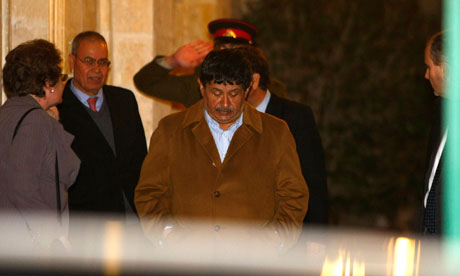
Libya's new foreign minister Abdel Ati al-Obeidi will present the proposal to Muammar Gaddafi, said Turkish government sources. Photograph: Darrin Zammit Lupi/Reuters
Turkey has proposed a path to a peaceful resolution to the deadlocked conflict in Libya, involving a withdrawal by Muammar Gaddafi's forces from cities held by the rebels, and democratic reform.
Recep Tayyip Erdogan, the Turkish prime minister, has outlined the proposal in Ankara, saying: "We are working on the details of this roadmap." It would include humanitarian corridors in Libya, he said.
Turkey, which this week hosted an envoy from the Gaddafi regime, the new foreign minister, Abdel Ati al-Obeidi, said the measures would be discussed at an international meeting on Libya in Qatar next week. The US, European countries and Middle Eastern allies will take part.
Obeidi was reported to be floating ideas for a three-country tour in search of a political solution, with Gaddafi staying in power while constitutional reforms were introduced. Libya's opposition and the international coalition reject any plan involving Gaddafi remaining in power.
Erdogan outlined three elements to his proposal: a ceasefire in the cities surrounded by Gaddafi's forces, including Misrata; a humanitarian corridor to allow aid to enter, co-ordinated with Tripoli; and negotiations leading to a new political process in Libya, including free elections.
Sources close to Erdogan said he had discussed the proposal with Obeidi, who would take the message back to Tripoli.
The Turkish government also met Mustafa Abdul Jalil, the chairman of the rebel council, in Doha recently. Jalil was said to have been "positive" about the proposal.
Meanwhile, Nato is investigating a claim by Libyan rebels that a botched air strike has killed at least 13 of its fighters as the west scrambled to deal with what commanders admit is a flaw in communications with rebels on the battlefield.
The revolutionary leadership sought to defuse anger at Nato over the strike near the frontline town of Brega, where several missiles hit rebel tanks, by claiming that it was carried out by Gaddafi's air force. That appeared unlikely given the imposition of the no-fly zone and the destruction of his air defences in recent days.
The Nato aircraft appear not to have been informed that, for the first time, rebels had moved several tanks, rocket launchers and other armour up to the frontline . All of it was seized from government forces and therefore was indistinguishable from Gaddafi's weaponry.
But the second Nato attack on rebel forces in less than a week deepened anger and suspicion about the actions of the alliance, which is accused in rebel-held areas of abandoning the fight against Gaddafi. Nato had been keen to assuage those concerns by demonstrating that it is still taking on the Libyan leader's army.
A rebel commander, Ayman Abdul-Karim, told the Associated Press that he had seen air strikes hit tanks and a rebel convoy, including a bus carrying fighters toward Brega. He and other rebels described dozens killed or wounded.
Rebel fighters who saw the strike were furious. "Nato are liars. They are siding with Gaddafi," said Salem Mislat.
Thirteen people, including three doctors, died last Friday in a western air raid after rebels opened fire with an anti-aircraft gun while a Nato plane was overhead.
Yesterday's incident came as western powers tried to improve slow communications between the rebels and Nato commanders, who are receiving old information about the situation on the ground.
A fresh assault by Gaddafi's forces appeared to be pushing the revolutionaries back once again. The government army advanced close enough to Ajdabiya, the last main town before the revolutionaries' de facto capital, Benghazi, to shell its western gate. That sent people fleeing in their thousands from Ajdabiya, which has changed hands several times.
The revolutionaries' military problems are being compounded by a looming economic crisis. Western governments that have established diplomatic ties with the revolutionary council are now urgently trying to find ways to legally get frozen Libyan assets to the rebel administration, which says it has less than a fortnight's cash available.
The matter is complicated by UN sanctions against Libyan state bodies, which appear to prevent western governments from transferring funds in to banks even in rebel-held territory. The US holds about £20bn in Libyan assets and Britain has several billion, but officials say releasing the funds is proving legally complicated.
The economic crisis is likely to be compounded by plunging oil production that was cut further on Wednesday by an attack on a pumping station. Nato dismissed the regime's claims that British planes were responsible for the attack, saying it was carried out by Gaddafi's forces.
The American general who heads the US's Africa command, Carter Ham, told Congress that he believes the conflict is settling into a stalemate. He advised against providing weapons to the rebels until the US is confident about who exactly they are, amid warnings from other members of the American military about ties to Islamist extremists.
However, that concern is rapidly receding among western diplomats dispatched to Benghazi to deal with the rebels who say that they have been impressed by a commitment to creating a free and democratic society.
Libyan spokesman Musa Ibrahim said he was not aware of the details of the plan, but added: "We are open to all proposals for reform from within Libya."
Friday, 8 April 2011
Thursday, 7 April 2011
150 migrants missing after boat from Libya sinks off Italy
Italian rescue vessels resume search for survivors – but hopes of finding anyone alive are fading, warns interior minister
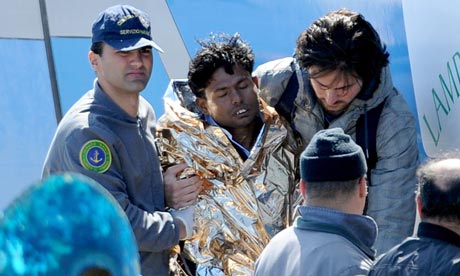
A survivor from the capsized boat, which set sail from Libya, is wrapped in foil and taken to Lampedusa for medical treatment. Photograph: Ettore Ferrari/EPA
Italian rescue vessels have resumed their search for survivors from the boat carrying refugees from Libya that sank south of Sicily on Wednesday but hopes of finding anyone alive are fading.
The interior minister, Roberto Maroni, said 51 people, most from central Africa, had been picked up by rescue vessels responding to a distress signal sent via Maltese authorities.
"Survivors said there were another 150 people, and the search for them is being conducted at sea at the moment with the help of two merchant ships," he told parliament. "The search is continuing but hopes of finding anyone still alive grow weaker by the hour," he said.
The incident was the most dramatic of its kind for some time, but many smaller boats carrying migrants have sunk while attempting to reach southern Europe from Africa, killing unknown numbers of refugees and migrants.
Officials said the boat, which left Libya on Monday and was loaded well above capacity, capsized after its motor failed. Although the vessel was in Maltese waters when it got into difficulties, Italian rescue ships were alerted because of a lack of appropriate vessels in Malta, Maroni said.
Survivors have been housed in a reception centre in Lampedusa, the southern Italian island at the centre of a recent north African migrant crisis, but there has been uncertainty about the number of people on the boat when it sank.
The International Organisation for Migration, an agency with officials on Lampedusa, says there were 300 passengers on board; Italian officials estimate there were 200.
Libya: US rebuffs letter from Gaddafi, says he must go
Rebel forces kept up attacks in the west on Wednesday
Continue reading the main story
Libya Crisis
Rebels race to train recruits
Frontline hospital
How war is being funded
Challenges facing coalition
The US has rebuffed a personal appeal from Libyan leader Muammar Gaddafi to US President Barack Obama, repeating that he must resign and go into exile.
"Mr Gaddafi knows what he must do," US Secretary of State Hillary Clinton said, commenting on the three-page letter received by the president.
Colonel Gaddafi urged Mr Obama in his letter to end an "unjust war".
An unconfirmed report from Libya says a coalition air strike has damaged a disputed oil pipeline.
Khaled Kaim, a deputy foreign minister in Col Gaddafi's government in Tripoli, told reporters that three guards had been killed and other staff injured during an air strike by British jets on the Sarir oilfield in the Sirte basin.
Continue reading the main story
“
Start Quote
I don't think there is any mystery about what is expected from Mr Gaddafi at this time”
Hillary Clinton
US secretary of state
However, the oilfield has been under rebel control, and the rebels reported attacks this week by Libyan government forces in the area, which forced a halt to oil production.
There was no immediate official comment from the UK's Ministry of Defence on the Libyan government report.
But on Wednesday afternoon, it reported that British jets had hit targets around Sirte and Misrata, attacking armoured fighting vehicles and tanks.
'Our son'
A White House spokesman responded to Col Gaddafi's letter, a copy of which was obtained by the Associated Press news agency, by saying actions, not words, were needed from the Libyan leader.
Tim Wilcox spoke to one of the opposition leaders, who wished to remain anonymous
American warplanes are no longer involved in the air strikes on Libya - a fact hailed by Col Gaddafi in his letter.
Referring to Barack Obama as "our son", the Libyan leader urged the US leader to end an "unjust war against a small people of a developing country", and dismissed the rebels as "al-Qaeda" militants.
His nation, he said, had been been hurt "morally" more than "physically".
Mrs Clinton said in Washington: "I don't think there is any mystery about what is expected from Mr Gaddafi at this time.
"There needs to be a cease-fire, his forces need to withdraw from the cities that they have forcibly taken at great violence and human cost...
Continue reading the main story
“
Start Quote
As you know too well democracy and building of civil society cannot be achieved by means of missiles and aircraft”
Libya's Colonel Gaddafi
Text of Gaddafi letter
"There needs to be a decision made about his departure from power and... his departure from Libya."
In another development, a former US congressman has arrived in Tripoli at the invitation of the Libyan government.
Curt Weldon says he will urge Mr Gaddafi to "step aside", and is suggesting that his forces pull back from western cities under siege while rebel fighters do not try to advance any further from the east.
The White House was informed about the visit in advance but a spokesman stressed that Mr Weldon was not an official envoy.
Change of tactics
Nato has promised to do everything it can to protect civilians in the west Libyan city of Misrata which is besieged by Col Gaddafi's forces.
Rebel leaders have predicted a massacre there within a week unless Nato takes more decisive action.
The BBC's Wyre Davies reports from rebel-held eastern Libya that rebel forces remain enthusiastic but ill-disciplined, despite attempts by the few former regular soldiers among their ranks to try to coordinate their operations.
It is a safe bet that after firing off their rockets and mortars in the general direction of the enemy, the same rebels will come charging back, unable or unwilling to dig in and take on Col Gaddafi's better-trained troops, our correspondent says.
Meanwhile, government forces have adapted their efforts to frustrate Nato air strikes, no longer using tanks or other military vehicles that could easily be identified and attacked.
They are using the same pick-up trucks and civilian guise as the rebel fighters, our correspondent says.
Col Gaddafi's opponents are still not in immediate danger of losing strongholds like Benghazi but nor are they in any shape to make significant advances on the ground without more Nato air strikes, he adds.
Subscribe to:
Posts (Atom)